

This is what adherence looks like in the real world.
Out of 130 who registered for the 2025 Unaging Challenge, seven logged their workouts and meals week after week for an entire year.
If each of them maintains these habits, they’ll add an average of 16 years to their expected lifespan.
Including participants who completed earlier phases and continued those habits, the 2025 Unaging Challenge saved an estimated 300 years of human life.
Nobody hit every target. And yet they showed up, week after week.
Congratulations to Anna, Domenic, J Mann, Jim, Jody, Kuba, and Kurt. You traveled, got injured, had holidays, struggled with logging. And yet you entered your diet and activities until the end, building habits that compound over time.
The Plate Challenge: Final Phase Results
The Plate Challenge was the fourth and final phase, following cardio, strength, and step challenges. Over three months, participants logged daily intake across seven food categories: unsaturated fats, whole grains, beans, fish, red meat, processed meat, and sugary drinks.
Average completion: 58%, with several challengers hitting 95-100% consistency.
Participant rating: ⭐⭐⭐ out of 5—though that average hides a love/hate split. Nobody rated it a 3. Participants either found the clear categories helpful (rating 4-5) or found logging overwhelming (rating 1-2).
How Food Categories Drove Longevity Hours
The Plate Challenge grouped foods into protective categories (adding longevity hours) and risk-increasing categories (subtracting them).
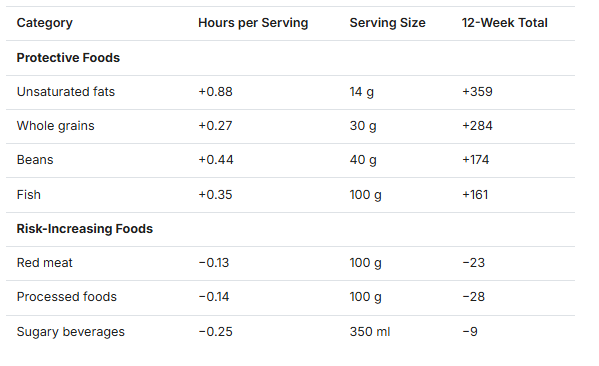
Net dietary contribution during the Plate Challenge: about 850 hours, or 35 days of projected life extension.
How We Calculate Longevity Hours
The numbers in this post aren’t arbitrary—they’re derived from epidemiological research on mortality.
Each intervention (walking, HIIT, eating fish, etc.) is quantified by its expected percentage change in All-Cause Mortality based on published studies. Using actuarial tables for a 40-year-old man, we adjust the normal probability of death in each year by the intervention’s effect. The difference in life expectancy between the baseline and adjusted tables gives years of life gained or lost, which is then divided into daily or weekly portions for tracking.
For example, walking 12,000 steps daily reduces All-Cause Mortality by 75%1. Applying this reduction to each year’s mortality probability results in 7.2 additional years of expected life for a 40-year-old man.
This approach lets participants see the cumulative impact of their choices—not as a precise medical prediction, but as a way to translate research into actionable feedback.
The Math of Stacking Foods
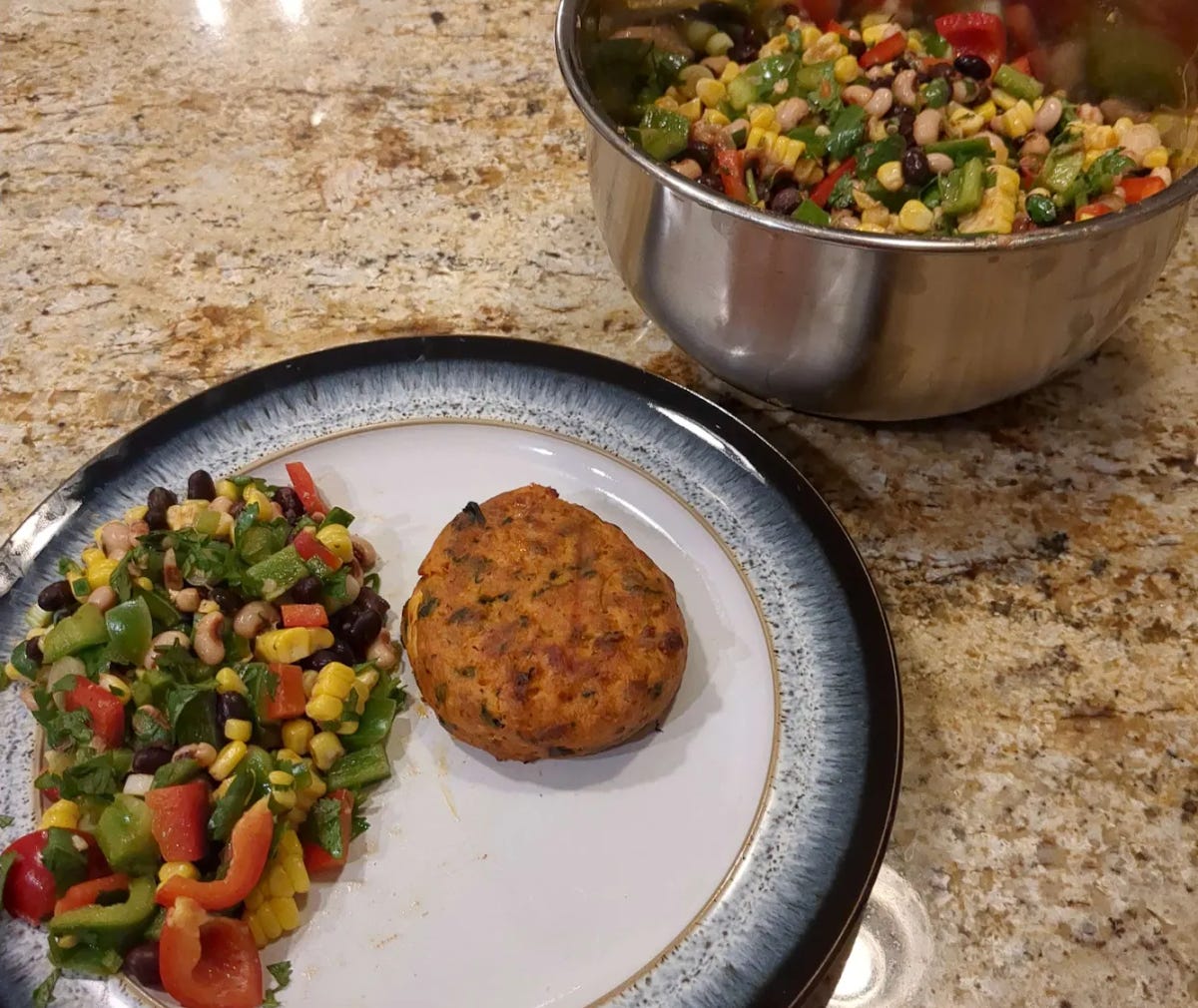
One insight from logging: protective foods easily outweigh the negative categories.
Unsaturated fats (+0.88) offset any single negative category
Beans (+0.44) cancel out red meat (−0.13) more than 3× over
Fish (+0.35) plus whole grains (+0.27) still net positive even with red meat (−0.13)
The overall gain came primarily from adding protective foods rather than perfect avoidance. Stacking two or three positive foods in one meal outweighs less ideal choices.
What Participants Said About the Plate Challenge
What worked:
“Good reminder to eat smarter”
“Motivated me to add wheat bread”
“Reasonable target, focus on key do’s and don’ts, without focus on calories”
“It helped me be more mindful with my eating habits”
What was hard:
“Way too many things to log”
“Sometimes I felt a bit confused about portion size despite guidelines”
One participant noted the challenge was difficult while dieting: “I often hit my calorie goal without enough room left to add in some fish or whole grains.”
Nutrition changes that stuck:
More beans, lentils, fish, and whole grains
Less red meat and processed snacks
Choosing whole wheat bread over refined grains
More intentional food choices overall
Ready to start your own transformation? The 2026 Unaging Challenge is underway, with registration open through February. Join now →
The Full Year: Unaging Challenge 2025 Results
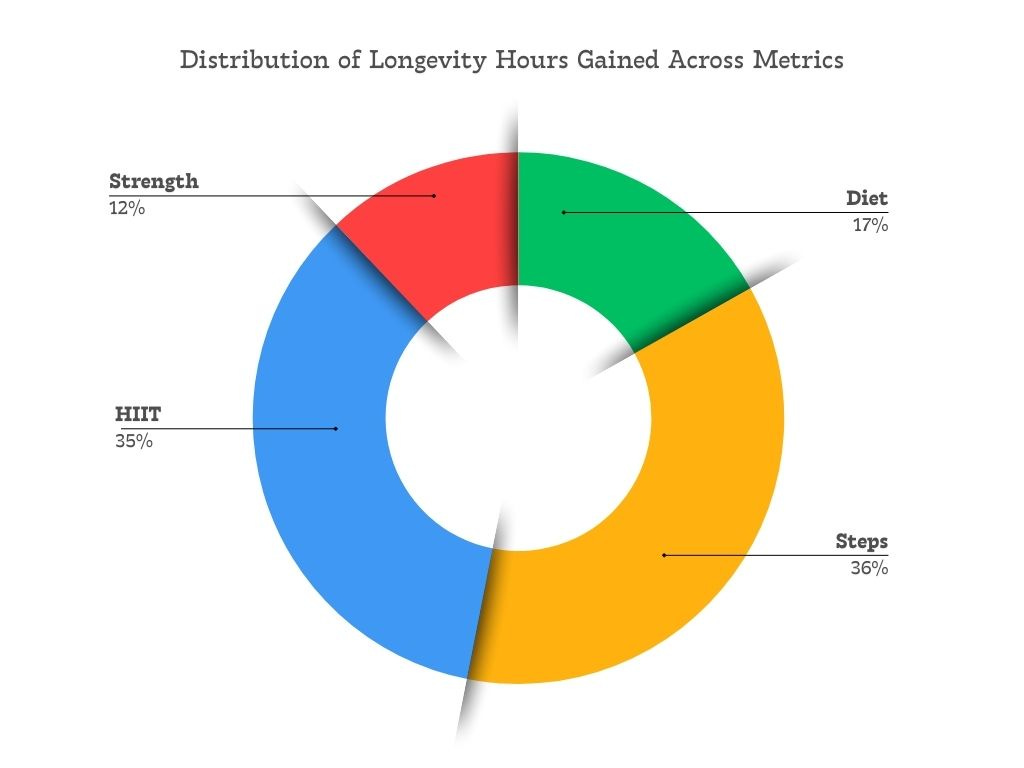
Here’s what a year of consistent health behavior produced across all four phases:
Why Steps and HIIT Contributed Equally
In theory, steps offer the largest opportunity for life extension—you can walk for hours daily without injury risk, and the mortality reduction from 12,000 daily steps is substantial2.
In practice, participants rarely hit 12,000 steps consistently. Work schedules, weather, and competing priorities meant the actual step counts varied widely.
HIIT, by contrast, requires just one 20-30 minute session per week. That’s easier to protect in a busy schedule. So despite the theoretical advantage of walking, HIIT and steps ended up contributing nearly equal longevity hours—participants completed more of their HIIT sessions than their step goals.
Diet contributed 17%. While meaningful, food logging proved the hardest category to implement consistently—hence the polarized ratings.
Strength contributed 12%. Participants found it effective but noted injuries and gym access as barriers.
Participant Spotlight: Kuba’s Results
One challenger’s eleven-month transformation shows what incremental improvement looks like for a regular person:
Starting point: 38-year-old with two small kids, office job, BMI 26, family history of hypertension and diabetes
After 11 months:
Resting heart rate: mid-60s → low 50s
Garmin VO2Max: 38 → 49
Fitness age: 52 → 32
His reflection: “These aren’t remarkable achievements—no sub-3:30 marathon, no Ironman. I didn’t radically change my diet and I’m not going to become a male swimwear model. But I’m genuinely happy that I found routines that work for a regular guy with a family and a job, who doesn’t have access to cutting-edge science or plasma exchanges. Step by step, I’ve been improving my habits, and with that, my health, fitness, and quality of life.”
Another participant noted: “Just wanted to say it’s been a real honor to have gotten to be a part of this. It’s really changed my life even though I’ve been far from perfect.”
What Changed Over the Year
From the survey responses:
Fitness changes:
“I dropped from 200 lb to 170... I feel much better about my diet and overall health outlook”
“I saw some solid results in RHR, HRV, and VO2 max from raising my daily step count”
“Some weight loss, definitely more strength and flexibility”
Habits participants will continue:
“Strength training, increased steps, high intensity interval training”
“I’ll probably keep shooting for 12,000 steps, and doing at least one HIIT session per week”
“Daily movement routine (HIIT, cardio, walking)”
“HIIT and strength training weekly. Eating more fish, oats, and legumes”
One participant captured the behavioral shift: “I literally feel bad if I spent my day at desk or sitting on couch.”
Challenge Ratings by Phase
PhaseRating (out of 5)Strength4.3Cardio (HIIT)4.3Steps4.0Plate (Diet)3.0
The strength and cardio challenges tied for highest rating, with participants noting they learned new techniques and could see clear progress. The Plate Challenge scored lowest due to logging complexity—though those who completed it reported lasting dietary changes.
Join the 2026 Challenge
The Unaging Challenge 2026 launched January 5th, but registration remains open through the end of February. Based on participant feedback, we’re adding more oversight on requirements to help participants stay on track throughout the year.
Registration is free. The accountability was cited as the program’s biggest benefit—join now and start building habits that could add years to your life.